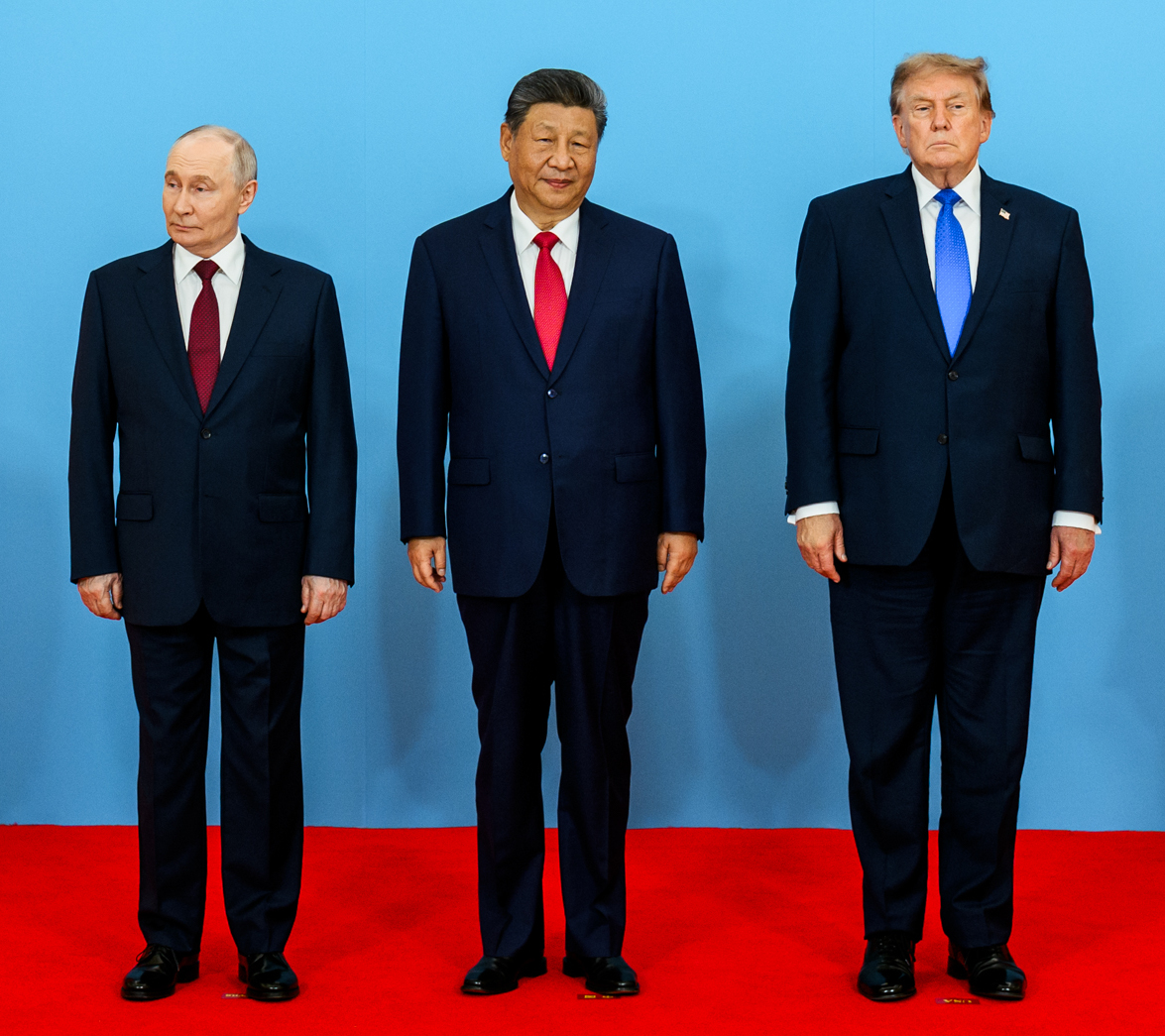
President Donald Trump said Thursday that reaching an agreement with China and Russia to limit nuclear weapons would be very hard. However, he pledged to continue pursuing a deal following a historic meeting with Chinese President Xi Jinping and Russian President Vladimir Putin.
Speaking to Reuters aboard Air Force One after the summit in Shenzhen, China, Trump acknowledged the challenges of persuading nuclear powers to reduce their arsenals.
“I love the concept of it but in terms of pure negotiation, it’s a very hard thing for me as a president to do,” Trump said.
The president said Xi supports the general idea of limiting nuclear weapons. However, he explained that convincing countries to surrender a significant portion of their arsenals presents a major obstacle.
Trump pointed to the difficulty of asking a country with 4,000 nuclear weapons to give up half of them.
He said he would continue pursuing an agreement “because it should be done, but it’s hard to do psychologically.”
The remarks followed the first-ever trilateral meeting between the leaders of the United States, China, and Russia, the world’s three largest nuclear powers.
The leaders met behind closed doors for nearly 90 minutes during the Asia-Pacific Economic Cooperation summit. Trump also held separate meetings with Xi and Putin earlier Thursday.
Following their discussions, the three leaders issued a four-point peace declaration affirming that nuclear war cannot be won and must never be fought.
They also pledged to maintain dialogue on reducing nuclear risks and preventing the spread of nuclear weapons. However, the declaration did not establish specific limits on their arsenals.
Before the meeting, Trump emphasized the importance of cooperation among the three countries.
“The three of us have a great deal to discuss, and we’ve already discussed a lot,” he said in his opening remarks.
Putin thanked Xi for hosting the meeting and emphasized the countries’ shared responsibility for maintaining international peace and security.
According to estimates from the Federation of American Scientists, Russia possesses approximately 5,420 nuclear warheads, compared with 5,042 held by the United States and 620 by China.
However, Beijing has been rapidly expanding its nuclear capabilities.
A Pentagon assessment released in 2025 projected that China could possess approximately 1,000 nuclear warheads by the end of the decade. Other Defense Department estimates suggest its arsenal could reach around 1,500 warheads by 2035.
The expansion has raised concerns among U.S. officials, who argue that traditional arms control agreements between Washington and Moscow are no longer sufficient.
China’s reluctance to participate in negotiations was apparent before Thursday’s summit.
According to The Washington Post, Chinese officials resisted the White House’s efforts to make nuclear arms reductions a central topic of the meeting.
Chinese Foreign Ministry spokesperson Mao Ning declined to confirm whether nuclear weapons would be discussed.
Before the meeting, one American official told The Washington Post that the administration did not expect a formal deal. Instead, the official described the gathering as an initial conversation about reducing nuclear weapons.
Rose Gottemoeller, a former chief U.S. negotiator for New START, suggested that a commitment to continued discussions would represent a meaningful first step.
Trump has repeatedly called for reducing nuclear arsenals, warning about the dangers posed by the world’s existing stockpiles.