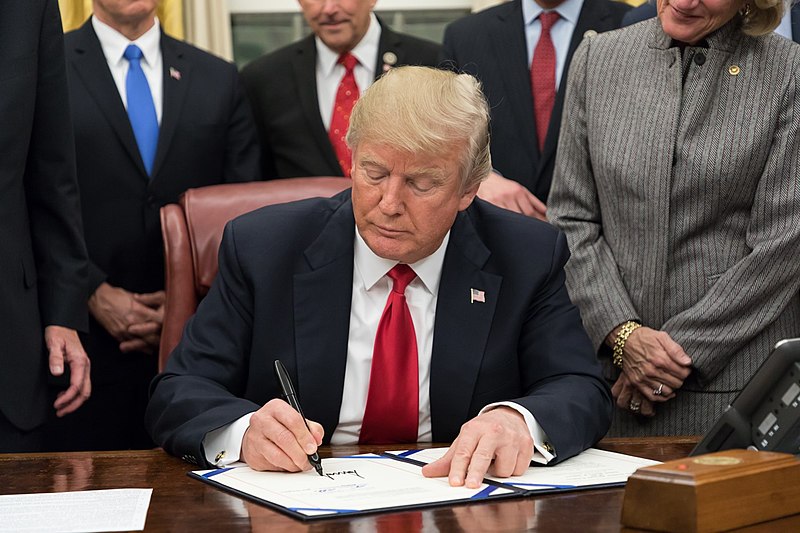
President Donald Trump signed an executive order Monday directing the federal government to compile a national list of eligible voters. The measure also tightens controls over mail-in and absentee ballots.
“The cheating on mail-in voting is legendary. It’s horrible what has been going on,” Trump said during the signing ceremony. “If you don’t have honest voting, you can’t have, really, a nation.”
The order is titled Ensuring Citizenship Verification and Integrity in Federal Elections. It instructs the Department of Homeland Security, working alongside the Social Security Administration, to build and distribute a State Citizenship List to each state’s chief election official.
The list will include confirmed U.S. citizens aged 18 or older who reside in the respective state. States will receive updated lists no fewer than 60 days before each regularly scheduled federal election.
The United States Postal Service is directed to initiate rulemaking within 60 days. All mail-in and absentee ballots must be sent in envelopes marked as Official Election Mail. Each envelope will bear a unique Intelligent Mail barcode for tracking and auditing purposes.
The USPS will also be prohibited from transmitting ballots to anyone not enrolled on a state-specific Mail-In and Absentee Participation List.
Will Scharf, White House staff secretary and assistant to the president, described the order as a pivotal move toward securing future elections. “We believe, combined, the measures in this order will help secure elections in the future and ensure the many abuses of our elections in the past are not repeated,” Scharf said.
Cabinet members also called on Congress to pass the SAVE America Act. The bill would impose voter ID requirements and further tighten election rules.
The Attorney General is directed to prioritize investigations and prosecutions of election officials or entities that issue ballots to ineligible voters. Federal funds may also be withheld from states and localities that fail to comply with federal election law.
Trump acknowledged the order would likely face legal challenges but dismissed concerns. “I don’t know how it could be challenged. It could probably be challenged if you find a rogue judge,” he said. “We will appeal if it is, but I don’t see how anyone else could challenge it.”
Democrats almost immediately called out the order. Sen. Alex Padilla (D-CA) said the order was unconstitutional. “This executive order is a blatant, unconstitutional abuse of power,” he said. “Trump’s attacks on our elections are a clear and present threat to our democracy.”
California Governor Gavin Newsom also rejected the order. His press office warned on social media that the state would pursue legal action.
Trump said voter ID and proof-of-citizenship requirements remain a priority for his administration. Those measures will be addressed separately. “That will be another subject for another time. We are working on that,” he said, pointing to polls showing broad public support for election security efforts.